Mental Load for Working Parents: The Weight You Carry That No One Else Can See

It’s 3am, everyone else is asleep, but your brain doesn’t let you get any rest. You carry so much on your mind that you cannot switch off. Appointments, deadlines, the present you need to organise for the birthday party your child was invited to last week. Wait - what are they going to wear? It's outside and it might rain. Their rain jacket is getting too small. You'll stop at the clothes shop on the way home tomorrow - but then who's dealing with dinner?…

Even on days when you manage to fall asleep early at night, you find you still can't concentrate at work. High mental load has a way of following you wherever you go. At work it manifests as divided attention, difficulty focusing, decision fatigue, and brain fog. At home, as resentment and a short temper.
If you are living with a partner, they are often unaware of the full extent of what you are managing - not out of indifference, but because so much of this work is genuinely invisible to those not doing it. You deal with the problem before it gets noticed so it never gets noticed.

What Is Mental Load
Mental load is the ongoing, invisible mental effort of managing a household and family - though it can apply to any system where one person carries disproportionate responsibility for keeping everything running. It is the anticipating, planning, deciding, and monitoring that runs constantly in the background. Unlike tasks you can tick off a list, mental load doesn't give you a break. The list is always being regenerated.
Research consistently shows it falls disproportionately on women, often without either partner fully recognising it.
Mental load of a working parent can include responsibility for:
Mental calendar - who needs to be where, when, and what they need to bring
Forever-updating household inventory - what's running low, what needs replacing, what needs booking
Emotional & social support - monitoring whether someone needs support, maintaining social connections
Forward planning - school holidays, medical appointments, birthday gifts, the car warrant
Assigning tasks to others - deciding what to ask someone else to do, explaining it, and following up
Delegating tasks doesn't always reduce mental load. If you're still the one who has to think of it, assign it, and check it was done - you have not reduced your mental load.
High mental load follows working parents everywhere, including to work.
Working parents often describe a constant sense of divided attention - part of their brain is always somewhere else. In a meeting, they're calculating whether there's time to pick up the prescription before childcare closes. Trying to meet a deadline, they're mentally rehearsing a conversation with their child's teacher at pick-up.
Over time, this affects concentration, decision-making, and creativity. It contributes to exhaustion that sleep doesn't fully fix - not because the work is too much, but because the mental bandwidth available for it has already been spent.
Many working parents also feel guilty about not being fully present at work, and not fully present at home either. This adds another layer to an already heavy load.
How to Lighten Mental Load
Mental load won't disappear, but it can be managed more sustainably. Here's where to start.
1. Acknowledge you are carrying too much
Mental load isn't a personal failing or a sign that you're disorganised. It's a real and significant cognitive burden. Naming it - to yourself, and to those around you - acknowledges that the current situation is unsustainable and helps you shift focus towards change.

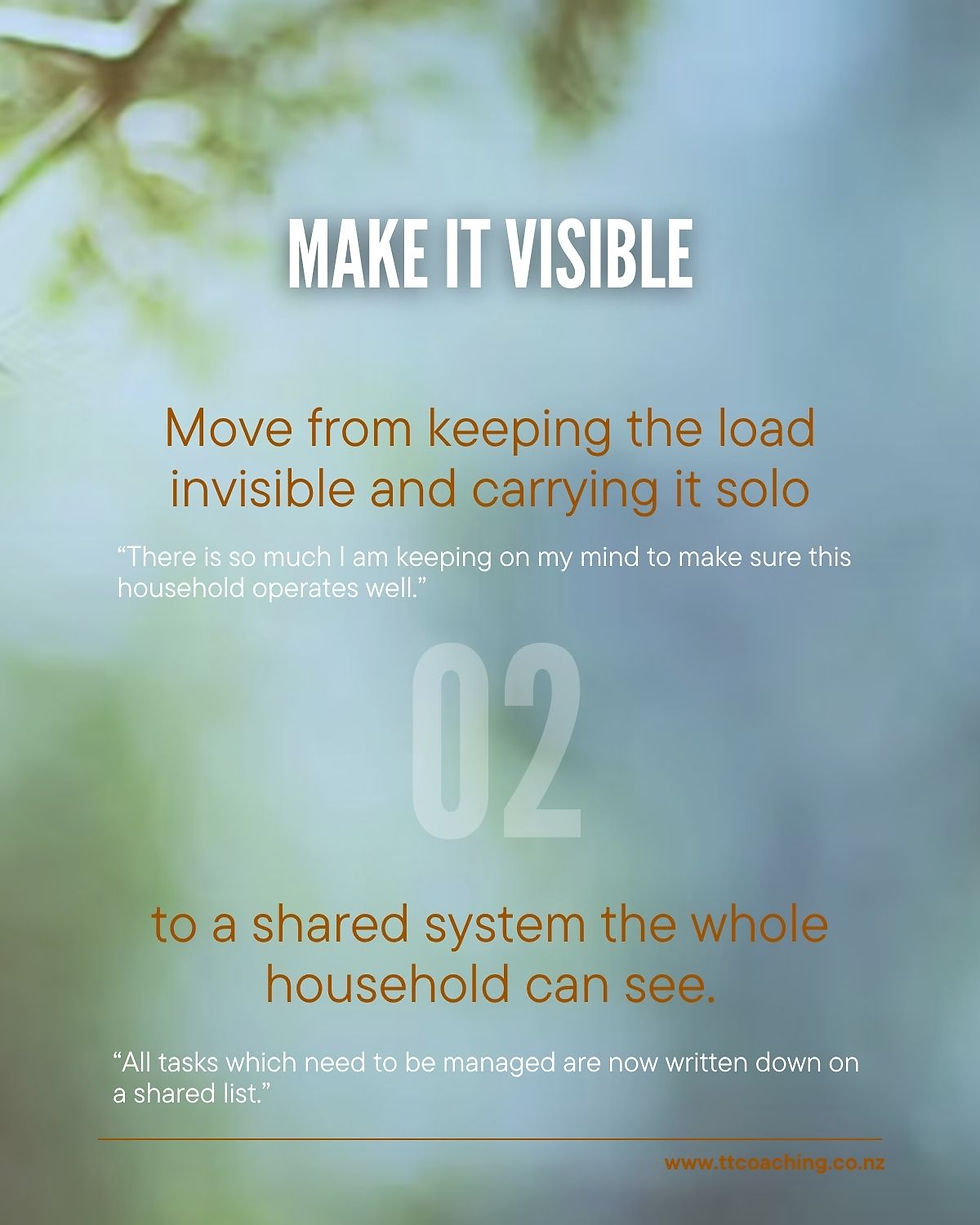
2. Make it visible
Write down everything you're currently managing - not just the tasks, but the tracking, the planning, and the thinking behind each task.
Shared lists, family calendars, and a regular weekly planning conversation help distribute awareness, not just tasks. A family meeting at the end of Sunday’s dinner about the week ahead can lighten your load significantly. I often recommend the Fair Play card game to my clients as a practical way to review and equitably divide responsibilities.
3. Transfer complete ownership
Redistributing mental load requires a conversation about ownership, not assistance.
Asking someone to help is not the same as asking them to be responsible. Assigning complete ownership of a domain - including the thinking and planning behind it - is what actually shifts the load. This applies to partners and to children; age-appropriate responsibilities reduce your load while building their independence. If you can afford it, some tasks can be fully contracted. Other tasks can be parked for later.

4. Set boundaries around your capacity
Mental load grows when there are no limits around what you take on.
Protecting your capacity means being intentional about what you agree to - at work, socially, and within the family.

5. Practice ‘good enough’ over ‘perfect’
When one person has been managing everything for a long time, a high standard can become the norm.
Releasing that standard - for yourself and for others - is not a failing. It's a necessary part of redistributing the load. If someone else does the school run differently, or packs the bag in a different order - and the outcome is fine: that is good enough. The goal is a sustainable share of responsibility, not a perfect outcome every time.

6. Prioritise yourself
When carrying a heavy mental load, your own needs are often the first to go. Rest is not a reward - it's how you recharge to function well.
Asking for help is not weakness - it's a practical response to an unreasonable load. And time for yourself, your interests, and your identity beyond your roles is not selfish. You cannot pour from an empty cup - and mental load empties it faster than most things.

When You Need Support
Sometimes the load has been heavy for so long that it's hard to see it clearly. You know you're exhausted, but it's not always easy to identify what needs to change or where to start.
Coaching can help you step back, look at what you're carrying, and work out what needs to shift - whether that's a conversation with your partner, a boundary at work, or simply permission to stop managing everything alone.
BOOK A FREE 20 MINUTE CONSULTATION, and let's explore what becomes possible when you have the right support.
About Tereza Tutko

Tereza Tutko is a strengths-based coach supporting working parents and organisations across New Zealand.
With a background in People & Culture leadership, a Master's degree in Psychology, a professional coaching qualification, focus on working with strengths and her own experience as a working parent, she brings a unique blend of scientific understanding, commercial experience, and practical insight to her work.
Tereza partners with working parents and progressive organisations to help them navigate the demands of working parenthood.


Comments